Luxury Martingale Dog Collars: Fit, Function, and Style Guide
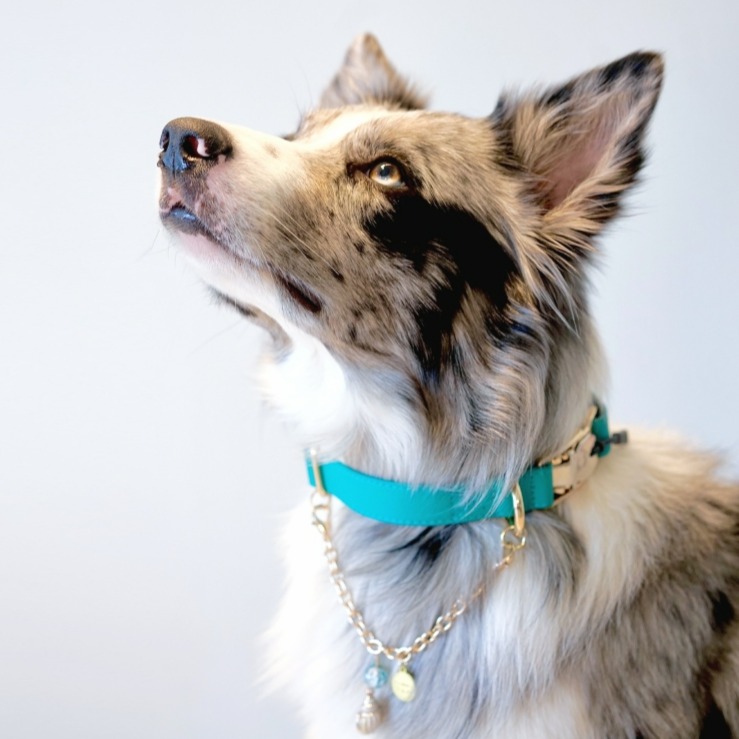
A luxury martingale dog collar combines a limited-tightening collar structure with refined materials and distinctive design. Its purpose is not simply decorative: when correctly fitted and used for supervised leash walking, the control loop can help the collar remain secure on dogs whose heads are close to the same width as—or narrower than—their necks.
Quick answer: how should a martingale collar fit?
A martingale collar should sit comfortably when the leash is loose and tighten only enough to help prevent the collar from slipping over the dog’s head. When the control loop is fully engaged, the collar should not continue tightening without limit. Measure both the neck and the widest part of the head, follow the product’s size chart, adjust the collar before the first walk, and confirm that the hardware does not constrict the neck.
Couture Capri’s Capri Dog Martingale Collar – Midnight Flare pairs a handcrafted collar body with elegant golden chain detailing and is currently offered in sizes Small and Medium.
What is a martingale dog collar?
A martingale collar has two connected sections: a main loop that sits around the dog’s neck and a smaller control loop. When the leash becomes taut, the control loop shortens the main loop by a limited amount. When tension is released, the collar relaxes again.
That limited movement is what distinguishes a martingale from a standard fixed collar. It can be useful for a dog that may back out of a conventional collar, but it is not a training shortcut and should never be adjusted to tighten without a safe limit. Correct measurement, supervision, and calm handling remain essential.
Who may benefit from a martingale collar?
A properly fitted martingale collar is often considered for narrow-headed dogs, dogs whose neck and head measurements are similar, or dogs that have previously slipped out of a fixed collar. Some pet parents also prefer the gentle change in tension as a clear leash-handling cue.
It may not be the right choice for every dog. Dogs that pull forcefully, lunge, have neck or airway concerns, or need specialized handling may require a harness, a different walking system, or guidance from a veterinarian or qualified trainer. A martingale collar should not be treated as a substitute for loose-leash training.
How to measure for a martingale collar
1. Measure the widest part of the head
Use a soft measuring tape around the broadest area the collar must pass over, usually including the ears. Keep the tape close without compressing fur. This measurement helps confirm that the collar can be put on and removed while still adjusting securely.
2. Measure the neck where the collar will sit
Measure the upper neck rather than allowing the tape to hang low on the shoulders. Keep the tape comfortably close and record the number instead of estimating by breed, weight, or an old collar size.
3. Compare both measurements with the current size chart
The collar must accommodate the head for dressing while adjusting correctly at the neck. Consult the Couture Capri Size Guide and use the instructions for the specific product. If the two measurements fall into different sizes or sit near a boundary, contact the brand before ordering rather than guessing.
4. Recheck after coat or body changes
A haircut, seasonal coat, weight change, or growth can alter the fit. Puppies and dogs with changing coats need more frequent measurement. Record the current adjustment so it is easier to notice when the collar has loosened or the dog’s proportions have changed.
How to adjust a martingale collar step by step
Step 1: begin with the collar relaxed
Open the adjustment enough to place the collar over the dog’s head without forcing it across the ears. Once it is in position, make gradual adjustments while the control loop remains relaxed.
Step 2: set a comfortable resting fit
The main loop should sit securely without constant pressure. It should not hang so loosely that it can slide over the head, rotate excessively, or drop far down the neck. Make sure fur is not caught in the chain, slider, or adjustment hardware.
Step 3: check the fully engaged position
Gently apply tension by hand to bring the control loop to its smallest intended position. The collar should become smaller, but the hardware should reach its designed limit before the collar constricts the neck. Follow the manufacturer’s instructions rather than relying on a universal gap, because martingale constructions and dog proportions vary.
Step 4: test movement indoors
Attach the leash to the designated load-bearing ring. Ask the dog to walk, turn, sit, and change direction in a quiet room. Gently guide the collar forward to assess whether it could slip over the head. Stop and readjust if the collar twists, catches fur, stays tight after the leash relaxes, or appears uncomfortable.
Step 5: take a short supervised first walk
Choose a familiar, low-distraction route. Watch how the collar responds when the leash changes direction, and confirm that the control loop relaxes again when tension disappears. Recheck the adjustment after the walk.
What makes a luxury martingale collar worth considering?
Thoughtful materials
Luxury should support comfort and repeated use. Look at the collar body, edge finish, flexibility, and the way the material sits against the coat. Premium appearance matters, but not at the expense of a stable fit or smooth movement.
Reliable construction
Inspect the stitching, adjustment hardware, leash ring, control loop, and every connection between them. Decorative chain can be part of the functional system, so its links, finish, and movement should be checked before every walk.
Proportionate design
Hardware should suit the collar width and the dog wearing it. Oversized decoration can add unnecessary movement or weight, while hardware that is too small may be difficult to handle. A refined design feels visually balanced from collar body to control loop.
A clear size and care system
A premium collar should come with understandable fitting and care information. Use the product instructions, and stop using any collar if the chain no longer moves freely, the adjustment slips, the material tears, or hardware becomes bent or damaged.
Safety rules for martingale collars
Use a martingale collar for supervised, controlled wear. Remove it before crating, sleeping, rough play, unsupervised time, or any situation where the control loop could catch on furniture, fencing, another dog, or surrounding objects. Never use it as a tie-out collar.
Attach the leash only to the intended ring, and do not add charms or pouches where they could interfere with the control loop. Check the complete collar before every outing and review Couture Capri’s Dog Accessory Safety Guidelines for additional precautions.
Martingale collar vs. magnetic collar
A martingale collar changes circumference within a limited range when leash tension is applied. A magnetic collar maintains a fixed circumference and uses a buckle for opening and closing. The right choice depends on the dog’s head and neck proportions, walking behavior, handling needs, and the owner’s routine.
For a detailed comparison, read Magnetic vs. Martingale Dog Collars: Which Luxury Collar Is Right for Your Dog?. If you are starting with broader collar considerations, see How to Choose the Right Luxury Dog Collar for Your Dog.
Styling a martingale collar with a complete walking set
Martingale collars can feel especially jewelry-inspired when polished chain becomes part of the silhouette. Midnight Flare uses an evening-inspired color story with golden chain detailing, creating a dramatic look while preserving the recognizable martingale structure.
Browse the martingale dog collar collection or compare all luxury dog collars. A coordinated martingale collar fashion bundle can bring the collar, leash, and walking accessories into one color story.
When choosing a leash, make sure the clip moves freely on the collar’s designated ring. Couture Capri’s convertible dog leash guide explains handheld, crossbody, and waist-worn configurations and when each may be appropriate.
Frequently asked questions
Do martingale collars choke dogs?
A correctly fitted martingale is designed to tighten only within a limited range. It should not continue tightening without limit or remain tight when leash tension is released. Incorrect sizing or adjustment can create risk, so measure carefully and supervise use.
How tight should a martingale collar be?
It should be comfortable when relaxed and become only small enough to help prevent slipping over the head when the control loop is engaged. Follow the specific product’s fitting instructions because dog proportions and collar designs vary.
Can a dog wear a martingale collar all day?
Martingale collars are best reserved for supervised wear and leash handling. Remove the collar during crating, sleep, rough play, and unsupervised time because the control loop can catch on objects.
Is a martingale collar good for pulling?
It can provide limited tightening and help maintain fit, but it does not teach loose-leash walking. Persistent or strong pulling may require a different walking setup and support from a qualified trainer.
Can a martingale collar slip off?
Any collar can fail to remain secure if it is the wrong size, poorly adjusted, damaged, or used inappropriately. Measure the head and neck, test the fully engaged fit indoors, and inspect the collar before every walk.
Can I use a regular leash with a martingale collar?
Use a suitable leash attached to the collar’s designated load-bearing ring. Confirm that the clip closes completely and does not obstruct the control loop or chain movement.
The bottom line
A luxury martingale dog collar should bring together measured fit, limited tightening, dependable construction, and intentional style. Measure both the head and neck, adjust the relaxed and engaged positions, test indoors, and reserve the collar for supervised use. When those fundamentals are right, details such as rich color and golden chain can elevate the walk without replacing the practical purpose of the collar.


Comments